
How Much Does It Cost to Replace a Fence Post?
Don’t ask “how much is one post?” Ask “what’s wrong with this section, and how many posts actually need fixing?”
Most cost articles will tell you fence post replacement runs “about $200” or “between $150 and $400.” That’s not wrong, but it’s almost useless. It doesn’t tell you whether that’s labour only or all-in. It doesn’t tell you what happens when you’re standing in 48 inches of heavy Halton clay and the old concrete is heaved out of the ground. It doesn’t tell you that the post you think is the problem is usually the least of your problems.
Here’s what actually happens when a homeowner in Milton calls about a leaning fence post, and what it really costs to fix it properly.
Who I Am and Why You Should Trust These Numbers
I’m a residential handyman based in Milton, Ontario. I’m not a licensed general contractor or a dedicated fencing company. My work falls under the typical handyman scope: repair and light construction on existing structures. That includes fence post replacement, board swaps, gate fixes, and small sections of fence rebuilds.
In Ontario, fence post replacement on an existing residential fence usually doesn’t require a special contractor licence or a building permit, as long as you’re not doing major structural changes or large new installations. That’s exactly the kind of job I handle regularly for homeowners in Milton, Mississauga, Burlington, and nearby areas.
Over the past five to seven years, I’ve personally replaced well over 100 fence posts across dozens of properties in and around Milton. That includes single rotted 4×4 posts on older pressure-treated fences, multiple posts on long property lines where frost heave and poor drainage caused leaning, upgrades from 4×4 to 6×6 posts where the original posts were undersized, and posts set in concrete footings, sonotubes, and compacted stone depending on soil and site conditions.
My process is always the same: I walk the entire fence line before touching anything. I look for drainage issues, soil problems, and other weak posts that tell me the “one leaning post” is actually a symptom of something bigger.
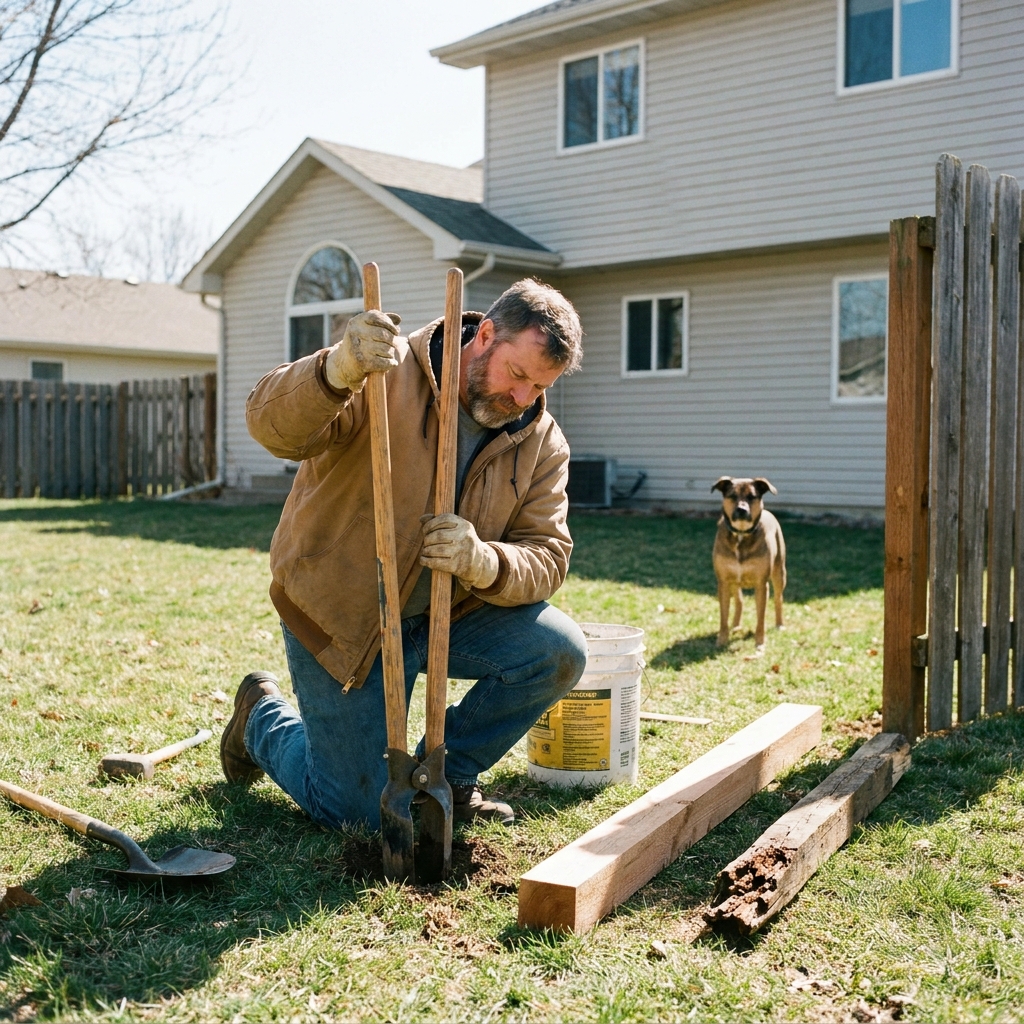
Real Fence Post Replacement Costs in Milton and the GTA
If you’re Googling “how much to replace a fence post” and seeing DIY material costs of $50 to $80, the surprise is that labour and time are what drive the real price. Digging out the old post and broken concrete, hauling it away, aligning and bracing the new post, pouring fresh concrete, and cleaning up is what you’re paying for.
Simple Single Post, 4×4, Good Access
For a straightforward single post replacement on an existing wood fence in Milton, 4×4 pressure-treated, dug out, new post, fresh concrete, reattach existing boards, the range I charge and see locally is:
- $250 to $350 all-in for one post.
That covers digging out the old post and broken concrete, setting a new pressure-treated post, pouring concrete, bracing while it cures, and reattaching the existing boards.
6×6 Post or Tighter Access
If the post is a 6×6 or you’ve got a tight side yard, a slope, or other access challenges:
- $300 to $450 for one post.
The extra cost is heavier posts, bigger holes, more concrete, and more time bracing and aligning.
Difficult Posts: Deep Rot, Frozen Ground, Damaged Boards
A “bad” post in Milton usually means one or more of the following:
- Deep rot at the ground line, sometimes with the concrete footing cracked or heaved from frost
- Frozen or very hard clay in early spring or late fall, making digging slower
- Surrounding boards warped, split, or nailed so badly they can’t be reused cleanly
- Gate posts or corner posts that carry extra load and need larger footings
For those jobs:
- $350 to $500 for a deeply rotted post in normal ground where you’re spending extra time cleaning the cavity
- $400 to $600+ for a post in truly difficult ground, frozen, rocky, or heavy clay, or where surrounding boards also need replacing
- $450 to $800 for gate posts or structural corner posts that need larger footings, deeper holes, and more careful alignment so the gate swings properly
If several pickets or a rail also need replacing, I add $10 to $25 per board and $40 to $80 per rail section. That can push a “single post” job toward $500 to $700 once everything is included.
Multi-Post Jobs and Volume Pricing
Here’s the part most articles skip: homeowners who think they need one post often need three or four.
When I walk the fence line, I often find 2 to 4 additional posts with similar rot, heave, or movement, especially on older fences 15 years or more, or sections with poor drainage. Many of us who do this work offer volume pricing on multi-post jobs. Instead of $300 to $350 for one post, I might do $225 to $275 per post when there are 3 to 5 posts in the same fence run.
So a homeowner who thinks they need one post at $300 might end up with three posts at $250 each for $750. That feels like a lot more at first glance, but per post it’s actually cheaper, and it solves the real problem instead of patching one symptom.
A Real Job: The “One Leaning Post” That Wasn’t
A homeowner in an older Milton subdivision called me saying, “One post near the gate is leaning. Can you just straighten it or replace that one?” From the photos they sent, it looked like a classic single-post job: 4×4 pressure-treated, concrete collar visible, fence maybe 15 to 20 years old.
When I got there, I did what I always do: walked the entire fence line before touching anything.
What I found:
- The “one leaning post” by the gate was definitely bad — rotted at ground level, concrete cracked, and the post had shifted a few inches
- Two posts on either side were also starting to lean in the same direction, and their concrete footings were heaved up on one side
- Behind the fence, along the neighbour’s side, there was a low spot where water pooled after rain. A downspout from the house was dumping roof water right into that corner
- The soil was heavy clay, and you could see old cracks in the concrete collars — classic frost-heave damage
The real problem wasn’t “one bad post.” It was poor drainage plus clay soil plus frost heave hitting a whole section of the fence, with the gate corner showing the worst symptoms first.
The homeowner was expecting something like “one post, maybe $250 to $300, done in an hour.” I laid out two options:
Band-aid fix: Replace just the worst post by the gate. Price: about $300 to $350. Risk: the neighbouring posts would likely keep moving with the next freeze-thaw cycle, and the fence line would still look wavy.
Proper fix: Replace the three worst posts in that section, improve drainage at the base, and regrade the surface so water runs away from the fence. This included digging out the old posts and broken concrete, adding a gravel base in each hole for drainage, setting new 6×6 posts upgraded from 4×4, pouring concrete with a slight slope away from the wood, backfilling with granular material instead of pure clay, and a rough regrade.
They chose the proper fix. Final invoice: $975 for three posts and the drainage improvements. The downspout extension was a separate task they had me quote later.
The twist wasn’t dramatic. No giant tree root or botched contractor story. But it was the kind of thing homeowners almost never think about: the previous owner or original installer had just dug holes in the clay, dropped the posts in, and poured concrete without a gravel base. Over 15 Ontario winters, water pooled in that corner, froze, expanded, and slowly pushed the footings up and over. That’s frost heave in a nutshell: cold plus water plus clay soil.
The homeowner learned three things:
- “One leaning post” is often a symptom, not the whole problem. If you only fix the worst one, you’ll be back out there in a year or two
- In Milton’s climate, drainage matters as much as post size. A 4 to 6 inch gravel layer at the bottom of the hole and granular backfill can make a huge difference in how long the repair lasts
- Paying $975 for three posts felt like a shock compared to their original “$250 job” expectation, but per post it was about $325, which is right in line with normal GTA pricing, and they got a section that finally looked straight and should hold for years
Why Your Quote Might Be Higher Than Your Neighbour’s
A lot of articles list a price range and stop. They don’t explain why the range is so wide. Here’s what actually drives the cost up in Milton and the surrounding Halton area:
Soil Type
Milton and Halton have heavy clay in many older subdivisions. Clay holds water, freezes hard, and heaves posts more than sandy soil. That means deeper holes, more gravel, and more labour. If your neighbour’s yard is sandy loam and yours is heavy clay, your post hole takes longer to dig and needs more drainage work.
Frost Line
Southern Ontario’s frost line is around 4 feet. Posts shallower than that will move over time. Articles written for warmer climates often understate this and suggest 2 to 3 feet, which is not enough here. In Milton, I dig to 42 to 48 inches minimum.
Access
Tight side yards, slopes, fences behind sheds, or fences with landscaping in the way all add time and cost. A backyard you can walk a mini-excavator into is a different job than one where everything gets carried by hand through a 30-inch side gate.
Post Role
Gate posts and corner posts cost more because they carry more load and need bigger footings and more careful alignment. A line post holds a few boards. A gate post holds a swinging gate that gets bumped every day.
Extra Work
Removing old concrete, replacing rotted rails and pickets, regrading for drainage, these can turn a “$250 post” into a $500 to $700 job. This is the part that surprises homeowners the most. They budgeted for a post. They didn’t budget for the rail that was already splitting or the two pickets that were so warped they’d never sit flat again.
DIY or Hire a Pro? My Honest Take
I’m not anti-DIY. If the job is small and low-risk, I’ll tell a homeowner to go for it. But I’ve also fixed a lot of “DIY repairs” that turned into bigger bills, and I want you to have a clear framework for deciding.
When DIY Makes Sense
I’d say DIY is reasonable when:
- It’s truly one isolated post, not part of a long leaning section
- The fence is on flat ground with easy access, no slopes or retaining walls
- You’re comfortable with basic tools (shovel, level, drill) and don’t mind a half-day of hard work
- You can call Ontario One Call to mark utilities, and there are no obvious underground hazards
In that scenario, material cost is usually $25 to $45 for the post, gravel, and bagged concrete, versus $250 to $350 for a pro on a simple single post. If you’ve got time and back strength, that’s a fair trade-off.
But if you go the DIY route, there are three non-negotiables:
- Depth: In Southern Ontario, aim for at least 42 to 48 inches deep, not “a couple of shovels down.” That’s your frost line buffer.
- Gravel base: 4 to 6 inches of crushed stone at the bottom so water doesn’t sit under the post.
- Plumb and brace: Use two 2×4 braces and a level. Don’t trust your eyes. One crooked post ruins the whole line.
If you can do those three things, you’ve got a fighting chance of a repair that lasts.
When to Hire a Pro
There are plenty of situations where I tell homeowners straight up: this is a pro job. I’d say “hire someone” when:
- Multiple posts are leaning or rotted in the same run. That’s almost always a systemic issue, drainage, soil, original install quality, not a one-off. Patching one post is just delaying the inevitable.
- The fence is on a slope, next to a retaining wall, or in heavy clay with known frost heave problems. Getting the footing right matters a lot more here, and mistakes are expensive.
- It’s a gate post or corner post. These carry extra load. If they’re wrong, the gate drags or the whole corner shifts.
- There are utility conflicts, buried debris, or you hit rock while digging. Hand-digging into unknown ground near gas or electric lines is not a weekend project.
- You have back issues, limited mobility, or no experience with concrete work. Digging out old concrete footings in clay is brutal and easy to do badly.
In those cases, the risk isn’t just a wobbly fence. It’s wasted money, injured backs, or hitting something you don’t want to hit.
Common DIY Mistakes I’ve Seen That Cost More in the End
- Too shallow: Posts dug only 18 to 24 inches deep in Ontario. They look fine in summer, then heave and lean after the first couple of winters. Proper depth in the GTA is 42 to 48 inches minimum.
- No gravel base: Post sitting directly on clay or soil, trapping water. That accelerates rot and frost heave.
- Wrong concrete profile: Concrete poured flat or dished toward the post, so water pools at the wood. It should be sloped away from the post to shed water.
- Not braced properly: Post set by eye, no braces, no level check. A few weeks later, it’s leaning again because it never cured plumb.
- Ignoring the rest of the fence: Fixing one post while the next two are already starting to move. That’s the classic “treat the symptom, not the disease” problem.
Each of those mistakes means you’re back out there in a year or two, often paying a pro to redo what you just did, plus the cost of the materials you already bought.
The “One Post” Mindset Is the Real Problem
Even when a DIYer does a technically perfect job on that one post, they’ve usually fixed the worst symptom but not the underlying cause. They’ve left neighbouring posts that are already compromised to fail next. They’ve created a fence line where one section is “new and solid” and the rest is still slowly moving.
From my perspective, the “one post” mindset is what drives a lot of repeat calls. Homeowners think they’re saving money, but they end up paying for multiple service calls or a bigger repair later because the root problem wasn’t addressed.
If I’m on site and see more than one weak post, I’ll say it plainly: “We can do just this one, but based on what I’m seeing, you’re likely going to be back here in a year. If we handle the whole weak section now, your per-post cost actually drops and the fence stays straight longer.” That’s not a sales pitch. It’s what I’ve seen play out over and over in Milton winters.
What Makes Milton and Halton Different
National or even broad GTA articles often miss local realities that directly affect your cost and how long the fix will last.
Clay Soil
Very common in Halton, especially in older Milton subdivisions. That means more heave, more rot, and a stronger need for gravel bases and deeper holes. If you’re in an older Milton subdivision with clay soil, assume your posts should be 42 to 48 inches deep with a 4 to 6 inch gravel base.
Frost Line
Around 4 feet in Southern Ontario. Articles written for milder regions understate this and suggest 2 to 3 feet, which is not enough here. Every freeze-thaw cycle pushes posts that aren’t deep enough a little further out of line.
Older Fences
Many Milton homes have 15 to 25-year-old pressure-treated fences installed when the neighbourhood was built. Those are hitting the end of their first life cycle now. That means “one bad post” is often part of a larger aging system. If your fence is 15 to 20 years old and you see one leaning post, expect that at least 2 to 3 posts in that run may need attention once a pro walks the line.
What Most Cost Articles Get Wrong
If I had to pick the single biggest problem with most fence post cost articles, it’s this: they treat fence post replacement as a commodity job. “One post, one price.” They give you a flat average with no context about soil, frost, drainage, or how many posts are actually compromised.
The result is that homeowners anchor on the low end of the range, “It should be about $200”, and then feel ripped off when a real quote for a difficult post in Milton comes in at $400 to $600. They don’t understand why their neighbour’s job was $300 and theirs is $550.
The fix is simple: lead with scenario-based ranges, explain why prices vary, and make it explicit that budgeting for a section rather than a single post is the smarter move. That’s what I’ve tried to do here.
Bottom Line: What to Actually Budget
If you’re a Milton or Halton homeowner standing in your backyard with a leaning fence post, here’s what to walk away with:
- One easy post, good soil, flat ground: $250 to $350 all-in with a pro. DIY materials around $40 to $80.
- One difficult post (gate post, corner post, heavy clay, extra boards): $400 to $700+ with a pro.
- A section of 3 to 5 posts (which is what you likely actually need): $225 to $300 per post with volume pricing. Total range: $675 to $1,500.
- Full fence replacement context: If you’re quoted $3,000 to $4,000 to replace 10 posts individually, that’s in line with market rates. But targeted repair on the worst posts can sometimes be done for $1,500 to $2,500 if only 5 to 7 posts truly need it, which is far less than a full new fence.
Don’t ask “how much is one post?” Ask “what’s wrong with this section, and how many posts actually need fixing?” Then you’ll budget for the repair that actually works, not the one that fails next winter.
If you’re in Milton, Mississauga, Burlington, or the surrounding Halton area and your fence is telling you something is wrong, that’s a conversation worth having before the next freeze.