
How High Is Too High for Mounting a TV?
If you’re wondering how high is too high for mounting a TV, the short answer is: if you’re noticeably tilting your head up to see the center of the screen while seated, it’s probably too high. But the real answer depends on your room, your seating, and how you actually use the space, not just what looks symmetrical on the wall.
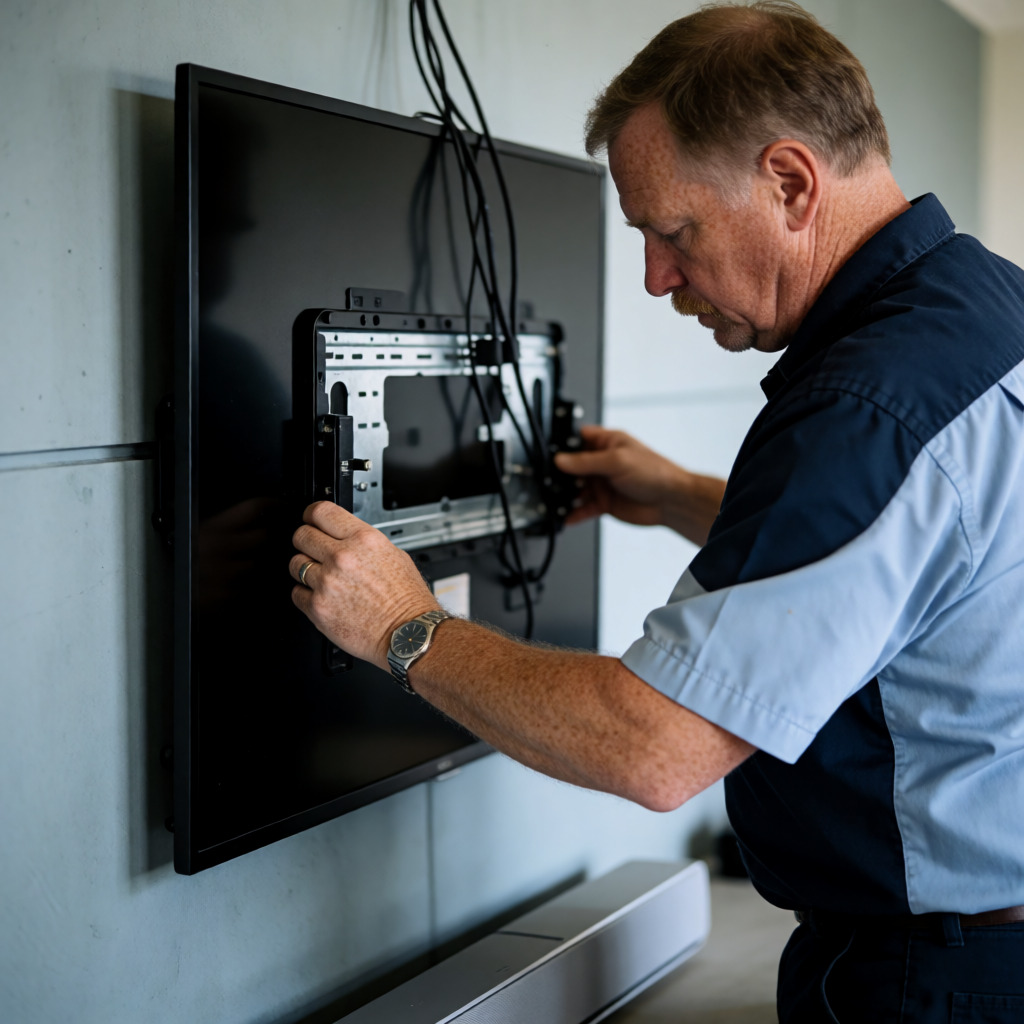
I’ve installed dozens of wall-mounted TVs in Milton homes, from straightforward drywall installs to tricky setups over tall stone fireplaces and in rooms with 12-foot ceilings. Over time, I’ve developed a practical, comfort-first approach that prioritizes how the TV feels to watch over how it looks on an empty wall. Here’s exactly how I decide the right height, and when I tell a homeowner, “Let’s not mount it there.”
My Rule of Thumb for TV Mounting Height
Living Rooms: 42–48 Inches to Screen Center
In a typical living room, I aim to place the center of the TV screen roughly 42–48 inches (107–122 cm) from the floor. This usually aligns the screen with seated eye level for most sofas and sectionals, so you’re not looking up or down at an awkward angle during a movie or game.
That range isn’t arbitrary, it’s based on average seated eye height and the ergonomics of relaxed viewing. If your sofa is particularly low or high, I adjust accordingly, but 42–48 inches is my starting point for almost every standard living room install.
Bedrooms: 48–55 Inches, Depending on Bed Height
In bedrooms, I generally go a bit higher, around 48–55 inches (122–140 cm) to the center of the screen. The exact height depends on the bed frame, mattress thickness, and whether the homeowner typically watches while sitting up or lying down.
If you’re mostly watching from a reclined position, a slight upward tilt can actually improve comfort. That’s why I often recommend a quality tilting mount for bedroom installs, especially when the TV ends up a bit higher than ideal.
Above a Fireplace: 50–60 Inches If Possible, But It Depends
Fireplaces are the most common reason TVs end up mounted too high. My preference is to keep the center of the screen around 50–60 inches (127–152 cm) from the floor, even above a mantel. But the final height has to respect three things:
- The fireplace and mantel manufacturer’s heat-clearance requirements
- The TV manufacturer’s installation guidelines
- The actual seating position in the room
If the fireplace forces the TV much higher than 60 inches to the center, I’ll be upfront: it’s going to be less comfortable for everyday viewing. In those cases, I discuss alternatives like a pull-down mount, relocating the TV to a different wall, or accepting that this will be a secondary viewing spot rather than the primary one.
Real Milton Case Studies: When “Too High” Became “Just Right”
Case Study 1: Tall Stone Fireplace in a Milton Living Room
A homeowner with a tall stone fireplace initially wanted their 65-inch TV mounted as high as possible above the mantel. The proposed position would have put the center of the screen around 66 inches (168 cm) from the floor.
I explained that while it would look visually balanced with the fireplace, it would be uncomfortable for normal sofa viewing. We had them sit in their usual spot and marked a lower position on the wall. We ultimately installed it with the center at about 55 inches (140 cm), while still maintaining the required clearance from the fireplace and following all manufacturer requirements.
The homeowner was initially worried it would look too low. After two weeks, they told me they were much happier with the lower position because they weren’t constantly tilting their head upward. The takeaway: visual symmetry isn’t the same as viewing comfort.
Case Study 2: High-Ceiling Living Room
Another client had a high-ceilinged Milton living room and wanted the TV mounted high because they felt a large blank wall looked awkward with the television sitting lower. Their first idea would have put the center of the TV at roughly 62 inches (157 cm).
I recommended bringing it down closer to 50 inches (127 cm). We temporarily marked the proposed height and had them sit on the couch before making any holes. We ended up installing it at approximately 51 inches (130 cm) to the center of the screen.
A week or two later, the homeowner said they were glad we’d talked them out of the original height. The TV still looked proportional to the room, but it was noticeably more comfortable for everyday viewing.
My approach in situations like this is simple: I don’t just say “that’s too high.” I mark both heights on the wall, have the homeowner sit in their normal viewing position, and let them see the difference for themselves. Once the TV bracket is drilled into the wall, changing your mind gets a lot more expensive.
Common TV Mounting Mistakes (and How I Fix Them on the Job)
Mounting Too High Above a Fireplace
This is the most common mistake I see. Homeowners often want the TV centered perfectly over the fireplace, even when that puts the screen well above comfortable eye level.
I correct this by measuring the proposed position and having the homeowner sit in their normal viewing spot before I drill. If the fireplace forces the TV higher, I’ll discuss whether a tilting or pull-down mount makes sense and make sure the installation respects all clearance requirements.
Assuming Bigger TVs Should Go Higher
With 75-inch or 85-inch televisions, people sometimes think the TV needs to be mounted high to make the room feel balanced. In reality, the center of the screen is still what matters most for comfortable viewing.
I measure the actual TV rather than guessing from its advertised size and mark the screen boundaries on the wall with painter’s tape. That gives the homeowner a much better idea of where the TV will actually sit once installed.
Measuring from the Bottom of the TV Instead of the Center
I’ve seen people say, “Let’s put the bottom of the TV 40 inches from the floor,” without considering the screen size. That can produce very different viewing heights between a 55-inch and an 85-inch TV.
I prefer to work from the center of the screen and the homeowner’s seated eye level, then calculate the bracket position from there.
Only Considering One Seating Position
In open-concept Milton homes, the TV is often visible from a sofa, sectional, dining area, or kitchen. Mounting it perfectly for one chair can make it awkward for everyone else.
In those situations, I look at the primary seating area first, because you shouldn’t sacrifice comfortable everyday viewing just to accommodate a secondary position. If the room has significantly different viewing angles, a tilting or articulating mount may be worth considering.
Centering the TV on the Wall Instead of the Room
A wall might be visually centered, but the furniture may not be. I always look at the sofa, seating arrangement, fireplace, windows, and walking paths before deciding on the final position.
Forgetting That the TV Will Look Smaller Once Mounted
Homeowners sometimes hold a TV against the wall and think, “That looks too low.” Once it’s actually mounted, the perspective can be completely different. That’s why I use painter’s tape to mark the approximate screen outline whenever there’s uncertainty.
My general approach on the job is simple: measure twice, mark it, have the homeowner sit down and look at it, then drill. Spending five extra minutes deciding the height is much better than spending an afternoon moving a TV mount because everyone realizes afterward that it was installed too high.
Special Considerations for Large TVs and High Ceilings
75-Inch and Larger TVs
For 75–85 inch TVs, I generally start by targeting roughly 45–55 inches (114–140 cm) from the floor to the center of the screen, then adjust based on the sofa height and viewing distance. I physically mark the screen on the wall with painter’s tape so the homeowner can sit down and judge it before we commit.
A big TV doesn’t necessarily need to be mounted high. The goal is to keep the screen comfortable at eye level, then use the rest of the wall to create visual balance. A TV that’s slightly lower on a big wall usually looks much better than a beautifully centered TV that everyone has to crane their neck to watch.
Rooms with 10-Foot or Higher Ceilings
For 10–12 foot ceilings, one strategy I use is keeping the TV at a comfortable viewing height and creating balance elsewhere rather than pushing the TV toward the ceiling. A console, low-profile cabinetry, artwork, or properly scaled wall treatment can help fill the vertical space without forcing the television into an uncomfortable position.
I also pay particular attention to:
- Stud locations: With an 85-inch TV, I want the mount securely attached to appropriate framing, not relying on drywall anchors alone
- Mount type: A heavy-duty fixed or tilting mount is often appropriate; an articulating mount can be useful when seating angles vary
- Viewing distance: A very large screen viewed from far away can sometimes justify a slightly different height than the same TV viewed from a close sectional
- Wall construction: Older Milton homes, finished basements, and feature walls can have different framing or backing arrangements, so I verify what’s actually behind the wall before selecting the mounting hardware
- Cable planning: With a large TV, I plan the cable route and outlet location before mounting rather than trying to hide everything afterward
- Fireplace clearance: If the TV is above a fireplace, I don’t use ceiling height as a reason to mount it higher. Fireplace and TV manufacturer requirements take priority
One of my favourite tricks is simply mocking up the entire TV footprint with painter’s tape. With an 85-inch TV, the difference between 50 inches and 60 inches to the screen center is surprisingly noticeable when you’re sitting on the couch.
Safety, Installation, and When to Call a Pro
Find the Structure Before Drilling
I always want to know what’s behind the wall before installing the mount. For drywall, that means locating the wall studs with a reliable stud finder and confirming their position rather than trusting the stud finder alone. For heavier 75–85 inch TVs, I want the mounting hardware properly secured to the structural framing or appropriate solid backing.
Match the Mount to the TV
Don’t choose a mount simply because it physically fits the television. Check the mount’s VESA pattern and weight rating, and make sure the rating comfortably exceeds the TV’s actual weight. I also prefer using quality hardware appropriate for the wall material rather than whatever screws happen to be in the toolbox.
Be Especially Careful with Brick or Stone Fireplaces
A fireplace feature wall can be much more complicated than drywall. Brick, natural stone, manufactured stone veneer, and the structure behind the finish can all require different approaches. I don’t recommend guessing where or how to drill, particularly with a heavy TV and an expensive stone finish.
If I’m dealing with an unfamiliar stone assembly, difficult access, or questionable substrate, that’s where I would rather stop and have the appropriate specialist assess it than risk damaging the wall or creating an unsafe installation.
Don’t Ignore Fireplace Heat
The fact that a TV physically fits above a fireplace doesn’t mean it belongs there. I check the fireplace and TV manufacturer’s requirements, the mantel configuration, and the expected heat exposure. If the location could expose the television to excessive heat, I recommend changing the location rather than trying to solve the problem after installation.
General industry guidance suggests maintaining at least 4–6 inches (10–15 cm) of clearance between the top of the mantel and the bottom of the TV, and more if the fireplace runs hot or the mantel is shallow. Some manufacturers specify even greater distances depending on the model.downloads.hearthnhome+3
Treat Cable Hiding as an Electrical Issue, Not Just a Cosmetic One
Running cables neatly inside a wall is different from simply stuffing extension cords behind drywall. Homeowners should follow applicable electrical requirements and use approved in-wall-rated cabling and methods where required. If a new electrical receptacle is needed, or the installation involves modifying household wiring, that’s a job for a licensed electrician rather than a handyman shortcut .
Know When DIY Isn’t Worth the Risk
I’d strongly consider calling a professional when you’re dealing with:
- An 85-inch-plus television that’s particularly heavy or awkward to handle
- A brick, stone, or unusual fireplace wall
- Uncertain or inadequate wall framing
- A TV being mounted very high or over a fireplace
- New electrical outlets or modifications to existing wiring
- Concealed wiring where you’re unsure what’s inside the wall
- A large articulating mount that puts significant leverage on the wall
- Any situation where safely lifting and positioning the TV requires multiple people
My rule on the job is don’t let the desire for a clean-looking TV installation override basic safety. Finding the structure, using the right mount and hardware, respecting heat clearances, and dealing properly with electrical work are more important than getting the TV mounted quickly.
And for a big-screen installation, I’d much rather spend an extra 30 minutes checking everything than have a homeowner call me two weeks later because their $3,000 television is sitting on the floor.
The Bottom Line: Mount for Comfort, Not Just Symmetry
The best TV height isn’t a single number, it’s the height that feels comfortable for how you actually sit and watch. In most Milton living rooms, that means 42–48 inches to the center of the screen. In bedrooms, 48–55 inches. Above fireplaces, as low as safely possible while respecting heat and clearance requirements.
Before any holes go in the wall, I always have the homeowner sit in their normal spot and preview the proposed height. That simple step prevents expensive regrets and ensures the final install looks great and feels even better to use.
If you’re in Milton, Mississauga, or the surrounding area and want a TV mounted at the right height, with proper stud locating, safe hardware, and clean cable management, I’m happy to help you get it done right the first time.