
Wood Fence Repair vs Replacement: Which Option Saves You More Money?
If you’re a homeowner in Mississauga, Milton, or anywhere across the GTA with an aging or damaged wood fence, you’ve probably asked yourself this question: should I repair it or just replace the whole thing? It’s a common dilemma, and the answer isn’t always obvious. Some contractors will push for a full replacement because it’s more profitable. Others might suggest a quick repair that doesn’t solve the root problem.
As a handyman who’s worked on hundreds of fences across the GTA, I’ve seen both scenarios play out. I’ve helped homeowners save thousands with smart repairs and I’ve also talked people into replacements when continuing to patch an old fence would’ve been a money pit. In this post, I’ll walk you through exactly how to make that decision, using real case studies, local cost data, and a simple checklist you can use during your own fence inspection.
How Fence Material Affects Repair vs Replacement Decisions
The type of wood your fence is made from plays a huge role in whether repair or replacement makes more financial sense. In my experience working in Milton, Mississauga, and surrounding areas, the two most common materials are pressure-treated pine and cedar, with board-on-board cedar being especially popular in older neighbourhoods and higher-end installations.
Pressure-Treated Pine: The Most Repair-Friendly Option
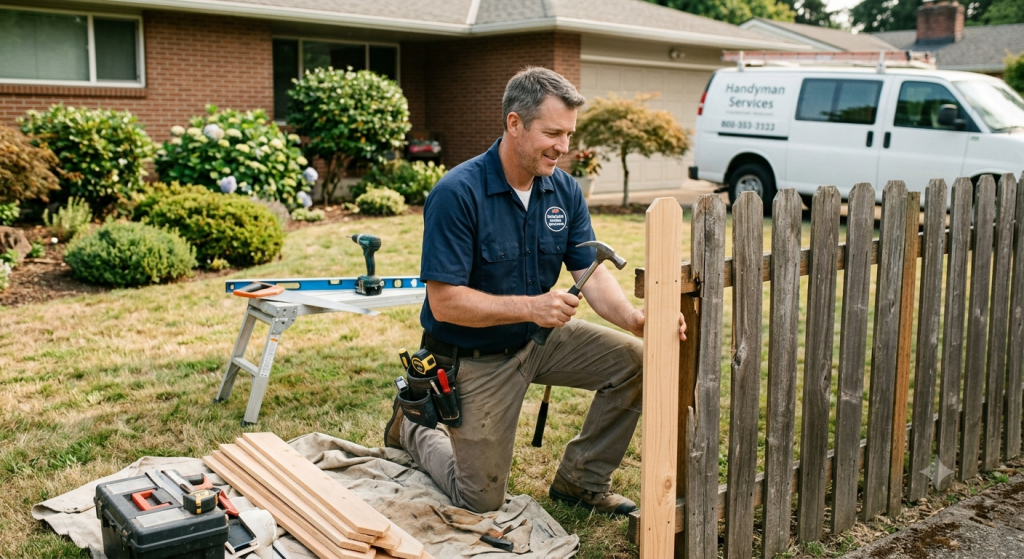
Pressure-treated pine is often the most repair-friendly option. If a few posts have rotted, some boards are damaged, or a section has been blown over by wind, targeted repairs are usually cost-effective because replacement materials are readily available and relatively affordable. If the fence is under 10–15 years old and most of the structure is still solid, repairing individual sections often delivers the best value.
Cedar Fences: Longer Lifespan, But Matching Can Be Tricky
Cedar fences tend to last longer and resist rot better, so I frequently recommend repairs when the damage is localized. Replacing a few cedar boards, rails, or posts can extend the life of the fence for several more years. However, matching older cedar can be challenging because new cedar often looks much lighter than weathered sections.
Board-on-Board Cedar: When Repairs Start to Add Up
With board-on-board fences, the decision becomes more complicated. These fences use more lumber and labour, so repairing a large damaged section can sometimes approach the cost of replacing an entire run. If more than 25–30% of the fence has failing posts, widespread rot, or significant leaning, replacement often makes more financial sense in the long run because you’re not continually investing in an aging structure.
One rule of thumb I often share with homeowners is that if the posts are still solid and the damage is mostly boards or rails, repair is usually worthwhile. If multiple posts are failing, the fence is leaning in several places, or the wood is deteriorating throughout, replacement is typically the better investment. The condition of the posts matters more than the appearance of the boards because posts are the foundation of the entire fence.
In the GTA’s climate with freeze-thaw cycles, heavy rain, and strong windstorms, the most expensive fence problems usually start below ground at the posts. That’s why a professional assessment of the post condition is often the deciding factor between a repair that lasts several years and a replacement that provides better value over the next decade or two.
Real Case Studies: When Repair Saved Thousands (and When Replacement Was Worth It)
Theory is helpful, but nothing beats real-world examples. Here are two actual jobs I’ve done in the GTA that show how the right decision can save you money or how the wrong one can cost you more in the long run.
Case Study #1: Homeowner Wanted Full Replacement, but a Repair Saved Thousands
A homeowner in Milton contacted me after a windstorm knocked over about 20 feet of their pressure-treated privacy fence. They assumed the entire 80-foot fence needed to be replaced because it was leaning and several sections looked rough.
After inspecting it, I found that the problem was actually limited to three rotted posts and a handful of damaged rails. The majority of the fence boards and remaining posts were still structurally sound.
What was wrong:
- Three failed posts at ground level
- Several broken rails
- Minor leaning in one section
- Fence was approximately 11 years old
Options considered:
- Full replacement: approximately $6,500–$8,000 CAD
- Repair: approximately $1,200–$1,800 CAD
We replaced the failed posts, installed new rails where needed, re-secured the existing panels, and straightened the affected sections.
Outcome:
The homeowner spent less than a quarter of the replacement cost. The repaired fence remained solid for another six years before they eventually replaced it as part of a backyard renovation. In practical terms, they saved several thousand dollars and got many more years of service from the existing fence.
Case Study #2: Homeowner Wanted Repairs, but Replacement Was the Better Investment
In Milton, a homeowner with a cedar board-on-board fence wanted to repair multiple leaning sections to avoid the cost of replacement.
At first glance, it seemed reasonable. However, once I inspected the fence, I found that nearly half the posts had significant rot at ground level. Several previous repairs had already been done, and many boards were splitting due to age.
What was wrong:
- Multiple failing posts throughout the fence line
- Widespread rot and splitting cedar boards
- Fence was approximately 20 years old
- Several sections had already been patched over the years
Options considered:
- Extensive repairs: approximately $3,500–$4,500 CAD
- Full replacement: approximately $7,500–$9,000 CAD
While the repair estimate was lower, it would have addressed only the most urgent failures. There was a strong chance additional posts would fail within a few years, leading to more repair bills.
Outcome:
The homeowner chose a full replacement. Although the upfront cost was higher, they avoided the cycle of ongoing repairs and received a new fence expected to last 15–20 years with proper maintenance. In this case, replacement provided a much better long-term return on investment.
The Common Pattern
The biggest factor is usually post condition, not board condition. Homeowners often focus on weathered or damaged boards because that’s what they can see, but I pay closest attention to the posts. If most of the posts are still solid, repairs often make excellent financial sense. If the posts are failing throughout the fence, replacement is usually the more economical decision over the long run, even if the initial price tag is higher.
Hidden Costs Homeowners Overlook When Choosing Repair vs Replacement
One thing I’ve learned after years of fence work in Milton, Mississauga, and throughout the GTA is that homeowners often compare only the immediate repair quote versus the replacement quote. The bigger financial picture usually involves several hidden costs and long-term factors that aren’t obvious at first.
The Condition of the Remaining Fence
This is probably the most overlooked factor. A repair might solve today’s problem, but if the rest of the fence is near the end of its lifespan, additional sections may start failing shortly afterward.
For example, a homeowner might spend $1,500–$2,000 CAD repairing a few posts and rails, only to need another $1,000–$2,000 CAD in repairs over the next few years as other aging components fail. In some cases, that money would have been better invested toward a complete replacement from the start.
I always encourage homeowners to look at the expected lifespan of the entire fence, not just the damaged section.
Removal, Disposal, and Landscaping Impacts
Many people focus on the cost of new materials but forget about what it takes to remove the old fence. Disposal fees, labour to extract old concrete footings, and hauling away debris can add a meaningful amount to a replacement project.
There’s also the landscaping factor. Replacing an entire fence often means crews need access along the fence line, which can result in temporary disturbance to gardens, shrubs, decorative stone, or lawn areas. A localized repair is usually much less disruptive.
In situations where only one section is damaged, preserving the majority of the existing fence can save money not only on construction costs but also on restoring landscaping afterward.
Future Maintenance and Property Appearance
A repaired fence can be the most economical choice structurally, but appearance matters too. New boards mixed with older weathered sections can create a patchwork look, especially on cedar fences.
For homeowners planning to sell within a few years, a complete replacement sometimes provides better value because it improves curb appeal and presents a more uniform appearance to potential buyers. On the other hand, if the goal is simply to maintain a safe, functional backyard for several more years, a quality repair often delivers the best return on investment.
Another consideration is maintenance. A new fence starts its service life over again, while an older repaired fence may require more frequent attention as additional components age.
What About Permits?
In most residential fence projects in Mississauga and Milton, homeowners are often surprised to learn that permits typically aren’t required for a standard backyard fence replacement, provided the project complies with local fence by-laws. However, height restrictions, corner-lot visibility requirements, shared boundary considerations, and utility locates can still affect the project. It’s always worth confirming current municipal requirements before work begins.
In my experience, the smartest decision usually comes from looking beyond the initial quote and asking one question: “What will this fence realistically cost me over the next 5–10 years?” Once you factor in future repairs, maintenance, appearance, disposal costs, and the condition of the remaining structure, the repair-versus-replacement decision often becomes much clearer.
My Simple Checklist: When to Repair vs Replace Your Wood Fence
When I’m walking a property with a homeowner in Milton, Mississauga, or elsewhere in the GTA, I usually keep the decision pretty simple. My rule of thumb is that repairs make sense when the fence still has good bones; replacement makes sense when the structure is failing in multiple places.
Here’s the quick checklist I use:
Lean Toward Repair If:
- Most of the posts are still solid and straight
- The damage is limited to one or two sections
- Less than about 25–30% of the fence needs work
- The rails and boards are generally in good condition
- The fence is under roughly 12–15 years old and hasn’t had repeated repairs
- You’re looking to extend the fence’s life by another 5–10 years rather than make it look brand new
In these situations, a targeted repair is often the best financial decision because you’re preserving a structure that still has plenty of useful life left.
Lean Toward Replacement If:
- Multiple posts are rotted, leaning, or failing
- Several sections have already been repaired over the years
- The fence is leaning in multiple areas, not just one spot
- Rot, splitting, or insect damage is widespread
- More than about one-third of the fence requires significant work
- The fence is approaching 15–20+ years old and showing signs of overall deterioration
At that point, repairs can become a cycle of spending money on one section only to have another section fail a year or two later.
My “Three-Question Test”
If a homeowner wants a quick answer, I ask:
- Are most of the posts still solid?
- Is the damage confined to a small portion of the fence?
- Can the repair realistically buy you at least 5 more years of service?
If the answer is yes to all three, I usually recommend repair.
If the answer is no to two or more of those questions, replacement is often the better long-term investment.
The biggest mistake I see homeowners make is focusing on how the fence looks rather than how it’s built. Weathered boards can often be replaced relatively inexpensively. Rotten posts throughout the fence are a different story. That’s why during any consultation, I spend more time checking the posts and structure than looking at the boards themselves. In most cases, the posts tell me within a few minutes whether we’re talking about a repair job or a replacement project.
One Piece of Advice I Wish Every Homeowner Knew Before Calling a Contractor
If there’s one piece of advice I wish every homeowner knew before calling a handyman or fence company, it’s this:
Don’t wait until the fence falls down to get it inspected.
Most of the expensive fence replacements I see could have been delayed for years if the homeowner had addressed a few failing posts or damaged sections earlier. A leaning fence, loose post, or small area of rot is usually much cheaper to fix than an entire section that’s collapsed after a windstorm.
I always tell homeowners to do a quick walk-around every spring. Push gently on the posts, look for leaning sections, and check for rot where the posts meet the ground. Catching problems early can save thousands of dollars in replacement costs.
How to Spot a Trustworthy Contractor
A close second is this:
Ask every contractor what percentage of the fence actually needs replacement—and why.
A trustworthy contractor should be able to walk you through the fence and show you exactly which posts, rails, or boards have failed. If someone immediately recommends replacing the entire fence without explaining the condition of the individual components, that’s a red flag.
When reviewing quotes, I recommend asking:
- How many posts are being replaced?
- Which sections can be repaired versus replaced?
- Does the quote include disposal and cleanup?
- What materials are being used?
- Is there any warranty on labour or materials?
The best contractors are usually happy to answer these questions in detail.
Red Flags to Avoid
As for scam warning signs, the biggest ones I see are:
- High-pressure tactics like “This price is only good today.”
- Contractors who won’t provide a written quote.
- Requests for large upfront cash payments.
- Extremely low bids that are far below everyone else’s.
- Vague descriptions such as “repair fence” without specifying materials, quantities, or scope of work.
A good fence quote should clearly explain what you’re getting and why it’s being recommended.
At the end of the day, the goal isn’t to find the cheapest quote or the most expensive solution—it’s to understand the actual condition of the fence. The homeowners who make the best decisions are usually the ones who ask questions, get a second opinion on major replacements, and address small problems before they become big ones. That’s often the difference between a $1,500 repair and a $8,000+ replacement a year or two later.